Cricket rivalries are usually settled on the pitch. But the brewing storm between Bangladesh and India has left the stadium and entered the halls of government.
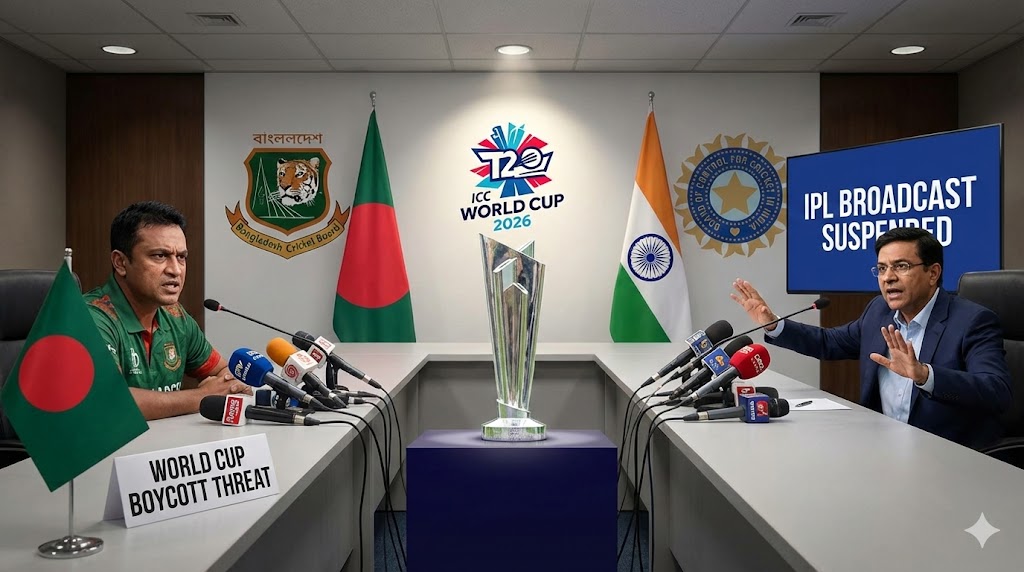
In a move that has stunned the cricketing world, the Bangladesh government has officially suspended the broadcast of IPL 2026 within its borders. But this “Bangladesh IPL Blackout” is just the tip of the iceberg.
Behind the scenes, a high-stakes diplomatic poker game is being played involving the BCCI, the Bangladesh Cricket Board (BCB), and the ICC. At stake? The integrity of the upcoming 2026 T20 World Cup.
Here is the deep dive into the most underreported controversy in cricket right now.
This incident raises significant concerns for cricket fans and players alike, as the implications of the Bangladesh IPL Blackout extend beyond mere television access.
Ashes 5th Test Day 2: 7 Spectacular Takeaways as Root’s Century Ignites SCG
Don’t have a streaming device yet? Here are the best options for watching cricket:
Fire TV Stick 4K
Roku Streaming Stick
Google TV Streamer 4K (Google Chromecast)
NVIDIA SHIELD Android TV Pro Streaming Media Player
The Trigger: The Mustafizur Rahman Allegation
Every geopolitical crisis has a flashpoint. In this case, reports suggest it centers on one player: Mustafizur Rahman.
According to multiple emerging reports, the friction began when the Kolkata Knight Riders (KKR) unexpectedly released the Bangladeshi pacer ahead of the season. While player releases are common, sources close to the BCB allege this was not a cricketing decision, but a political one mandated by the BCCI.
The narrative in Dhaka is that the BCCI “instructed” franchises to distance themselves from Bangladeshi players due to ongoing political tensions between the two nations. Whether true or perceived, this move was interpreted by the Bangladesh Cricket Board not as a team tactic, but as a national slight.
The Retaliation: The IPL Blackout
The reaction from Dhaka was swift and unprecedented.
Usually, the IPL is a massive revenue generator for broadcasters in Bangladesh. However, the government’s decision to block the feed is a calculated financial blow. It sends a clear message: If our players are not welcome in your league, your league is not welcome on our screens.
This “IPL Blackout” does two things:
- Financial Impact: It cuts off a significant viewership chunk for advertisers targeting the South Asian market.
- Public Sentiment: It rallies local fans around their national team, painting the BCCI as the aggressor.
The Nuclear Option: Moving the World Cup?
If the story ended with a TV ban, it would be a minor spat. But the BCB has escalated the situation to a level that threatens the ICC’s flagship tournament.
With the 2026 T20 World Cup set to be co-hosted by India and Sri Lanka, Bangladesh is scheduled to play several group-stage matches in India. The BCB has reportedly issued a formal request to the ICC with a startling ultimatum:
“Move our matches to Sri Lanka, or we don’t play.”
Citing “safety concerns” for their players and traveling fans, the BCB is borrowing a page from the Pakistan Cricket Board’s (PCB) playbook. They are demanding a “Hybrid Model” similar to the Asia Cup, where they play exclusively in neutral venues (Sri Lanka).
The BCCI Stance and ICC’s Nightmare
For the BCCI, accepting this demand is a non-starter. Agreeing to move matches would be an admission that India is unsafe for visiting teams—a PR disaster they cannot accept.
For the ICC, this is a logistical nightmare.
- If they agree: They look weak and set a precedent that any nation can dictate their schedule based on political grievances.
- If they refuse: They risk a full boycott by a Test-playing nation, devaluing the World Cup and angering a massive fanbase.
Conclusion: A New Rivalry is Born
For decades, the “India vs. Pakistan” narrative has dominated cricket geopolitics. But 2026 has birthed a new, equally volatile friction point.
The Bangladesh IPL Blackout is no longer just about T20 franchises or broadcast rights. It is a standoff about respect, sovereignty, and safety. Unless a diplomatic backchannel opens up soon, the 2026 World Cup might be remembered less for the cricket, and more for the matches that were never played.
FAQs about the Crisis
Why is IPL 2026 banned in Bangladesh? The Bangladesh government suspended the broadcast following alleged mistreatment of Bangladeshi players like Mustafizur Rahman by IPL franchises, viewing it as a politically motivated exclusion.
Will Bangladesh boycott the 2026 World Cup? The BCB has threatened to forfeit matches scheduled in India if they are not moved to a neutral venue like Sri Lanka, citing security concerns.
Which Bangladeshi players are in IPL 2026? Currently, no Bangladeshi players are featured in the active squads for the 2026 season, which is the core reason for the friction.