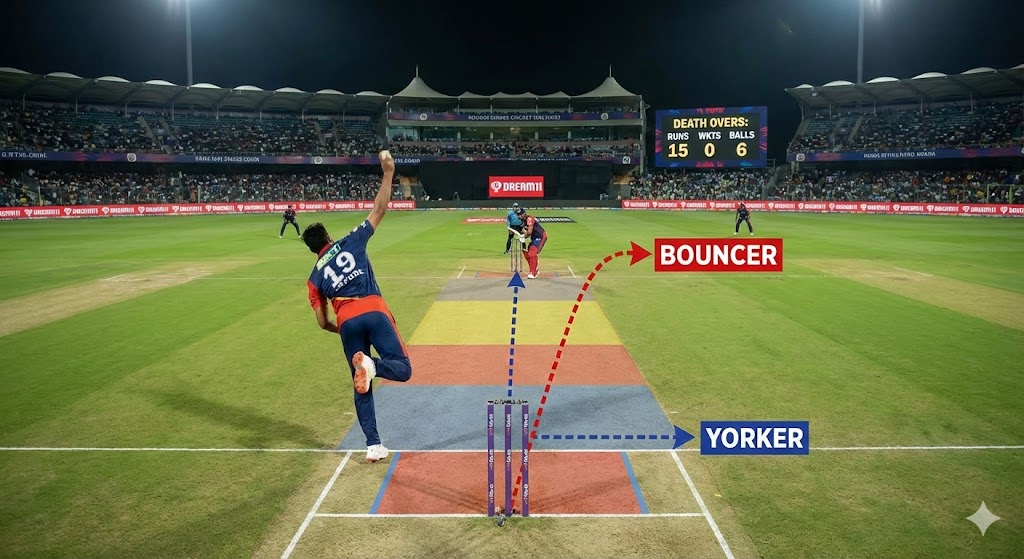
If you watched cricket in the 90s, the equation for the final overs was simple: aim for the toes. The yorker was the ultimate weapon—a “toe-crusher” that Wasim Akram and Waqar Younis used to destroy batting lineups.
By learning from the Crisis, bowlers can improve their chances of success.
But in modern T20 cricket, something strange is happening. The yorker is disappearing.
Watch a frantic finish in the IPL or the T20 World Cup today, and you are more likely to see a wide delivery or a slow bouncer than a classic stump-to-stump yorker. Why has the most lethal ball in cricket history been abandoned?
The answer isn’t a lack of skill—it is a calculated survival strategy known as the Death Bowling Crisis, which highlights the urgency of addressing the ongoing Crisis in T20 cricket.
This highlights the ongoing Crisis in T20 cricket that needs urgent attention.
Read The Death Bowling Crisis: Why Yorkies are Disappearing from T20 Cricket
Don’t have a streaming device yet? Here are the best options for watching cricket:
Google TV Streamer 4K (Google Chromecast)
NVIDIA SHIELD Android TV Pro Streaming Media Player
The Death Bowling Crisis reveals significant challenges faced by bowlers in today’s game.
The Math: Why The Yorker is a Bad Bet
To understand why bowlers have stopped bowling yorkers, you have to look at the “Risk vs. Reward” ratio.
In the modern era, the margin for error has vanished. Analysis from recent T20 leagues shows a terrifying statistic for bowlers:
- A Perfect Yorker: Economy Rate of 4.5 – 6.0 RPO (Runs Per Over).
- A Missed Yorker: Economy Rate of 11.0+ RPO.
In this context, the Crisis of confidence among bowlers is evident.
The problem is the “Missed Yorker.” If a bowler misses their length by just six inches, the ball becomes a “low full toss” or a “half-volley in the slot.” With modern heavy bats and smaller boundaries, these miss-hits don’t just go for four—they go for massive sixes.
Such statistics underscore the Crisis that T20 bowlers continually face.
This ongoing Crisis affects how matches are played and strategies are developed.
Data suggests that even elite bowlers only land a perfect yorker about 30-35% of the time. That means 65% of the time, they are risking a boundary delivery. In a game decided by fine margins, that is a gamble many captains are no longer willing to take.
The Evolution of Batting Stances
Batters have also evolved to kill the yorker.
Ten years ago, batters stood still. Today, players like Suryakumar Yadav, Jos Buttler, and Glenn Maxwell use the crease to manipulate the bowler’s length.
- Standing Deep: By standing deep inside the crease, a batter turns a “perfect yorker” into a “length ball” that can be pumped down the ground.
- The Shuffle: Batters pre-meditate movement across the stumps. If a bowler aims for the toes, the batter is already in position to scoop it over fine leg (the “Dilscoop” or lap shot).
This movement destroys a bowler’s confidence. You cannot bowl a static target when the target is moving every second.
The New King: Hard Lengths and Slow Bouncers
If the yorker is dying, what is replacing it?
The “Hard Length” (hitting the deck hard, back of a length) has become the new safety net.
- Hard Lengths: Even if you miss your spot slightly, a hard length ball hits the splice of the bat. It rarely goes for six.
- The “Two Bouncer” Rule: Recent rule changes in tournaments like the IPL allow two bouncers per over. This has been a game-changer. Bowlers can now push batters back, making them fear the short ball. This is far safer than aiming for the toes and missing.
- Wide Yorkers: Instead of attacking the stumps, bowlers aim specifically for the “tramline” (the wide line). This forces the batter to reach for the ball, taking away their power.
The Exception: The Bumrah Factor
There is, of course, one major exception to this rule: Jasprit Bumrah.
Bumrah (and perhaps Lasith Malinga before him) is an anomaly. His unique action allows him to land yorkers with a success rate far higher than the average bowler. Because his execution is so precise, he doesn’t fear the “slot ball.”
However, trying to copy Bumrah is dangerous. Most young bowlers do not have his hyper-flexible wrist or unique release point. When average bowlers try to be Bumrah, they end up serving full tosses that cost their team the match.
Conclusion: Is the Yorker Gone Forever?
The yorker isn’t dead, but it is no longer the default option. It has become a surprise weapon rather than a stock delivery.
In the high-pressure cooker of T20 cricket, consistency is valued over brilliance. A bowler who bowls six “hard length” balls for 8 runs is now more valuable than a bowler who tries six yorkers, lands two, but goes for 18 runs.
Until the balance between bat and ball shifts again, expect to see fewer toe-crushers and more chest-high bouncers in the death overs. The Death Bowling Crisis has forced evolution, and right now, safety comes first.
This changing dynamic in cricket is partly due to the ongoing Crisis in bowling strategies.
The Death Bowling Crisis has fundamentally changed how the game is approached.
FAQs about Death Bowling
Understanding the nuances of this Crisis is essential for future bowlers.
The strategies surrounding death bowling are evolving due to this Crisis.
Many players are adapting to counter the Crisis presented by modern batting techniques.
Ultimately, addressing the Crisis in bowling could redefine T20 cricket.
What is “Death Bowling” in cricket? Death bowling refers to bowling the final few overs of a limited-overs innings (usually overs 16-20 in T20s). It is considered the hardest time to bowl because batters are looking to hit every ball for a boundary.
Why are wide yorkers so popular? Wide yorkers keep the ball away from the batter’s “hitting arc.” Even if the batter connects, they often lose power because they are reaching for the ball, leading to catches in the deep.
Who is the best death bowler in the world right now? Most experts consider Jasprit Bumrah (India) the best death bowler due to his ability to bowl yorkers and slower balls with varied pace consistently.